Ah, glory, posterity, what happiness for a celebrity of this world to see his features sculpted in marble or cast in bronze (well, when I say “cast” …!). A statue of Putin!
If there’s one country that excels in this art form today, it’s the USSR. Oh sorry, Russia! And Vladimir Vladimirovitch Putin, born on October 7, 1952 in Leningrad as everyone knows, is making news. Dear Vladimir, if he were only content to pose (after all, we don’t want the sinner to die), we could forgive him this self-sufficient, narcissistic fracas. In this way, he would join the long line of great figures and politicians whose memory is known to us, and frankly, a politician who would encourage artists by entrusting them with work isn’t bad, is it? Most probably would Donald Trump on the other side of the Atlantic envy the same decision!
It’s funny (if you’ll pardon the digression) that dictators, tyrants and other autocrats the world over all have this immoderate taste for statuesque reproduction, a sort of lebensborn1. Perhaps even a fear of death for themselves, and a way of exorcising it! Remember Putin in the Kremlin at the time of Covid, at the end of a long, long white marble table facing Emmanuel Macron! And what about those statues of all sizes and materials, in China for Mao, and in North Korea for the members of the Kim 백두혈통 dynasty?
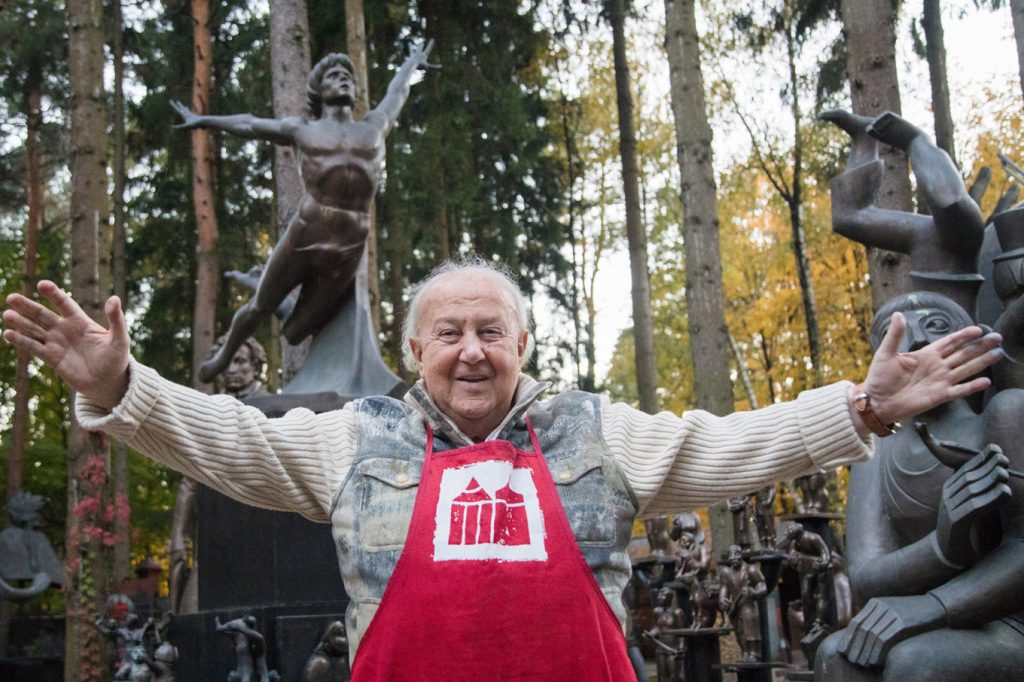
Do you know Zurab Tsereteli, a Georgian sculptor? God rest his soul, he died last week in Moscow at the age of 91. He was president of the Russian Academy of Arts.
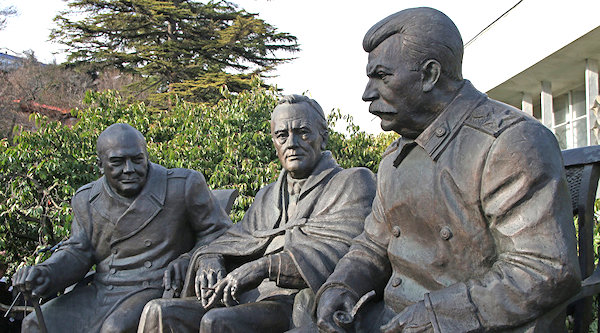
Photo: RIA Novosti, Artem Kreminski
Initially known as a ceramist, his reputation began to develop in the 70s when he worked on decorating tourist resorts around the Black Sea. He broke away from Soviet socialist realism, as it was known, which depicted and celebrated the heroes of the kolkhozes or the Red Army (not to mention all those potentates, but the allusion has already been made) with big arms, roguish looks and carnivorous jaws.
Zurab Tsereteli traveled extensively, meeting Picasso in Paris in 1964, and even General de Gaulle, whose sculpture he would later create (a clickable 8-metre statue on a 10-metre pedestal, positioned at the front of a Moscow hotel). In 1980, he was appointed chief decorator for the Moscow Olympic Games. In Moscow, he helped rebuild the Church of Christ the Savior, seat of the Russian Patriarchate, where his good friend Patriarch Kirill, a close friend of Putin’s and former KGB member, reigns.
His reputation, however, hardly extended beyond the borders of the Russian Empire. A monumental statuary group depicting Christopher Columbus, commissioned by the USSR in 1991 to celebrate the 500th anniversary of the discovery of America, was planned, donated and installed in New York, but ultimately, despite the support of a certain Donald Trump, ended up in exile in Puerto Rico.
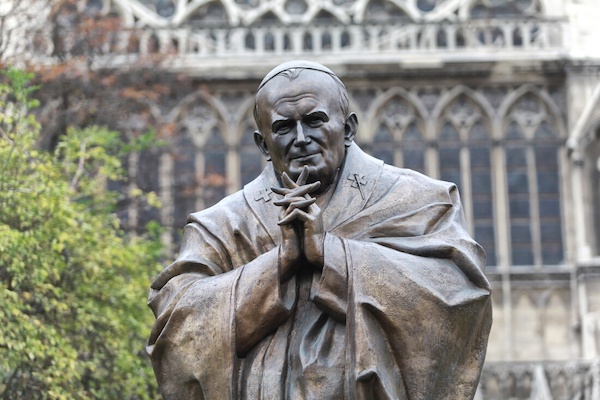
© photo Yannick Boschat. Diocèse de Paris
In Paris, a Tseretely statue of Pope John Paul II was unveiled in 2014 in the square bordering Notre-Dame Cathedral. In London, a statue entitled ‘Break the Wall of Distrust’ can be seen at 108 Cannon Street. Click
©photo Alexei Belkin/ TASS
More interesting, however, is the statue of Peter the Great in Moscow. Let’s not forget that the great Peter hated Moscow, which is one of the reasons why he had the Northern Capital he gave his name, St. Petersburg, built. It’s also called the Monument to the 300th Anniversary of the Russian Fleet. It’s true that since the maritime defeat of the Tsushima Straits, a naval battle that pitted the Russian fleet against the Japanese between May 27 and 29, 1905, and in which 45 Russian ships were sent to the bottom, the glory of the Russian fleet – well, never mind!
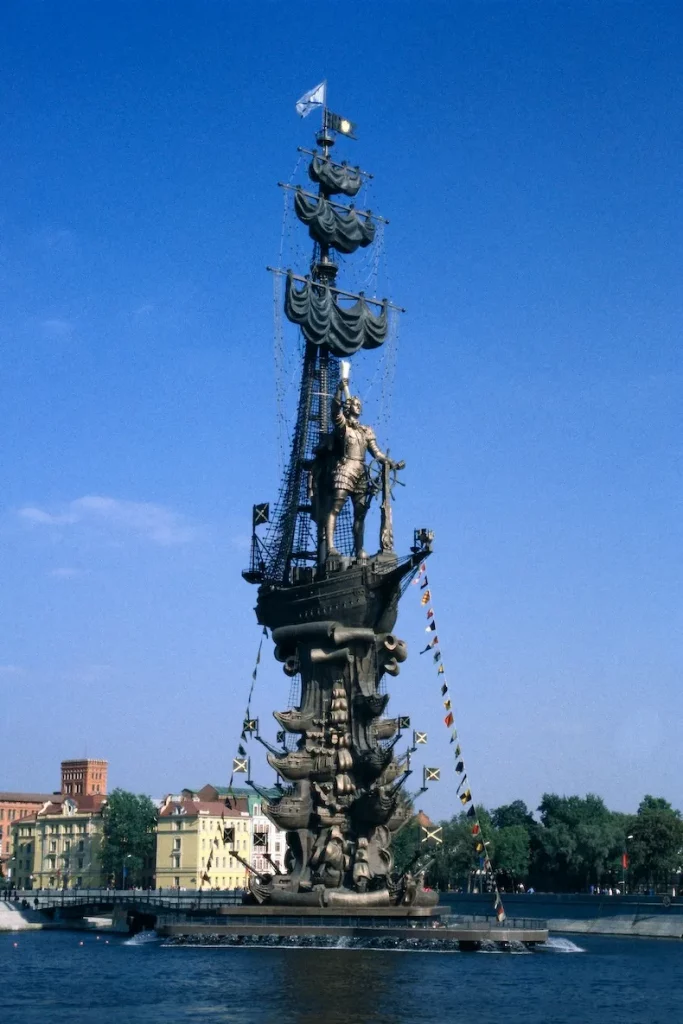
Photo Imagno/Getty images
It shows Peter the Great with a map in his hand. The statue had originally been designed to celebrate Christopher Columbus’ arrival in the New World, but was rejected by the countries that were supposed to glorify the event and host the work, led by the United States. Never mind, the figure of Peter the Great was substituted for the head of Christopher Columbus, and so it was done. A statue of colossal proportions, 98 m high – by way of comparison, the Statue of Liberty in New York, with its pedestal, is 93 m high. There’s something kitschy and heteroclite about it, a touch of Peter Pan, an adulescent dimension and accumulation, an air of bric-a-brac, a comic-book feel, and a few paving mistakes, it would seem.
A purely technical achievement. The monument’s load-bearing frame is a stainless steel construction to which the bronze parts of the cladding are attached. The lower third of the entire construction was assembled separately, then fixed to a reinforced concrete foundation. Likewise, the figure of Pierre, the construction and the trim of the ship were assembled separately, and then fixed to the pedestal. Fountains were installed at the base of the plaza/artificial island, to give the impression of a ship breaking through the waves.
And then, and then (I’m sure you’ve been waiting for this), at last, the statue of Vladimir Putin, the immortal work of Zurab Tsereteli, the star, dare I say it, “American” (that’ll please Trump!).
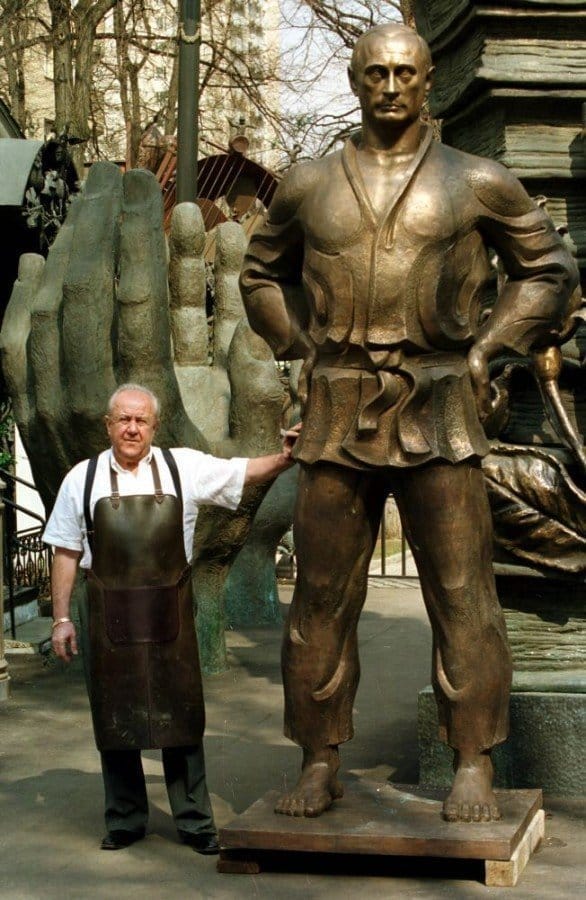
Ah, what a beautiful work, an ode to good taste and refinement! Anyone who sees in it a courtesan’s servility to the master of the Kremlin (I can already hear the criticisms flying) would be nothing but mediocre histrionics and jealousy! Because frankly, this judoka, strapped into a kimono that gives a glimpse of an athletic torso, a torso the likes of which are unheard of even in sports halls (except perhaps in papier-mâché for carnival characters or as heroes in Hollywood blockbusters or Japanese manga), is not always to be found at the head of a state. What a face, what a posture, Dear Vladimir!
It smells of testosterone and musk, of virility and strength, and let’s get on with our psychoanalysis, hands placed like a framing device at hip level, like a virtual baldachin for a trumpeted, boasted masculinity, centrality if not focal point and Gordian knot of the character, it’s strong isn’t it? In a word, a man who has guts (ndlr: French original differs…)
As for the photo of Vladimir’s statue (Влади́мир Влади́мирович Пу́тин) (it’s amazing how familiar we’re becoming!) that we present, it’s only a draft for a statue that should be 30m high and was to be installed in Arkhangelsk, nearly 600km from Moscow in Murmank. The people of St. Petersburg, for whom it was intended, didn’t want it – how ungrateful!
Yes, what can we say about the servility of men, some of them anyway, who gravitate towards the powerful! Money makes and breaks reputations, political power acts like hypnosis. Zurab Tsereteli was a great friend of Putin, to whom he owes his title of President of the Academy of Arts. A very wealthy man, he had bought the former German embassy and turned it into his studio. Not just anyone can be an apparatchik and member of the nomenklatura !
But perhaps, who knows, for Tsereteli, this is the subliminal expression of an unspoken critique, of a concealed, subterranean, political analysis. Pleasing one’s master and wallowing in courtesan complicity, the better to bring out vices and virtues surreptitiously, but without saying so, all the while flattering, and for other, very different audiences, and for a few wallets of rubles too… It’s confusing anyhow !
Sans la liberté de flatter, il n’y a pas d’éloge flatteur1.
Not just anyone can be Goya. Yes, but we’re dealing with a sculptor here!
1/ some sort of a nazi nursery for so called genetic aryan transmission
2/ «Without the freedom to criticize, there can be no flattering praise». Pierre-Augustin Caron de Beaumarchais (1732-1799). Le mariage de Figaro.
WUKALI est un magazine d’art et de culture librement accessible sur internet
Vous pouvez vous y connecter quand vous le voulez…
Pour relayer sur les réseaux sociaux, voir leurs icônes en haut ou en contrebas de cette page
Contact ➽ redaction@wukali.com